Dairy Goat Genetics

Don’t you wish you could choose a buck for a particular doe that would “fix” a trait on that doe herself? I know, right? If only it were that easy…

My daughter’s animal science textbook listed the hereditability of traits for all different types of livestock so I pulled out just the dairy goat info, and then after searching the internet to see if I could add to it, I found the same chart I just made on the ADGA website. Apparently anything over 15% is worth paying attention to and once you get above 30% you have a good chance of carefully improving your herd. But still, if you think about it, a trait that is 30% hereditable means that you should have a 15% influence from each parent. So where does the other 70% come from? It’s a mix from grandparents. So when looking at that pedigree, get to know the grandparents as it seems they contribute more than the parents do!

Time to choose a buck!

Dairy Goat Trait Heritability
Stature 52%
Strength 29%
Dairyness 24%
Rump Angle 32%
Rump Width 27%
Rear Leg Angulation 21%
Fore Udder Attachment 25%
Rear Udder Height 25%
Rear Udder Arch 19%
Medial Suspensory Ligament 33%
Udder Depth 25%
Teat Placement 36%
Teat Diameter 38%

Wiggans, G.R. and Hubbard, S.M., Genetic evaluation of yield and type traits of dairy goats in the United States.  Journal of Dairy Science 2001.                             
How to House Train a Goat


IMG_8574
Little Honey at the bank with Elaine

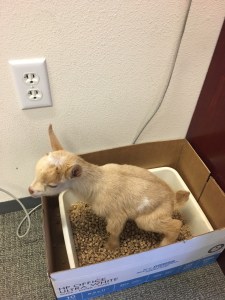
Aspen was house trained for the first nine months. It was really not that difficult and well worth the effort. We brought her home when she was a week old so she lived in the house with us. We took her out on a leash and told her to “go potty” on the lawn and squatted down next to her. While she squatted, we scratched her and praised her. We made sure we took her frequently and crated her when we couldn’t watch her. It worked really well and she never made a mess. Once she was 6 weeks old, she was launching herself off the table and prancing on my laptop so she got exiled to the goat pen. In order to keep up her training, we took her in the car with us and always provided her with frequent lawn visits.  We kept a look-out for good pit stops, pulling over when she let us know she needed to go. Even now, when prompted, she usually squats to “try” whether she really has to go or not.

It’s easy when they’re babies, but once they’re grown up, I’m not sure it would be that successful.

Goat Eye Color

One of the fun things about Nigerians is that they can have brown or blue eyes.  Or amber. That’s not an official color, but Aspen clearly has golden eyes. Her sire has blue and it took a couple of days to be sure that hers weren’t going to be blue like his.  I’d love to know what made hers amber instead of brown.

Comon belief is that blue eyes are dominant, which means that if you pair a heterozygous blue-eyed goat with a brown-eyed goat, you have a 50% chance that each baby will have blue eyes. An interesting thing that we noticed is that Clark has brown spots in his blue, and so does his daughter, Pinecone.

If you pair two heterozygous blue-eyed goats together, you have 75% chance that each baby will have blue eyes.

And if you pair a homozygous blue-eyed goat with a brown-eyed goat, all babies will have blue eyes.

We don’t have any homozygous blue goats right now, but I might end up with some by crossing blue with blue. The only way to tell will be by breeding the blue-eyed offspring a couple times to brown-eyed goats and waiting to see if there are any brown-eyed babies.

*Note- I’ve been doing more reading after going to a show where there was another amber-eyed Nigerian, and I found a website on which the writer assumes there are four alleles for eye color instead of just two. After reading through the charts, I think this makes more sense but I can’t find anything else to back it up. The article does include the reasoning for why some blue-eyed goats have brown color mixed in (like Clark and Pinecone), how amber is a separate color (like Aspen), and how two brown-eyed parents can have blue-eyed offspring. Of course this makes things a whole lot more complicated and a lot less predictable!   http://goatspots.com/genetics/blue-eyes/

Backyard Forage for Goats

If you have goats, you know they beg like dogs, but now it’s official, according to researchers in London. Our goats stand at the gate to their pen and stare longingly at our back yard, begging to come out and eat the landscaping. Really, we haven’t had time to landscape yet and besides the trees, there’s mostly weeds, a little ivy, and a very ugly jade plant I haven’t had time to dig up. Well, the goats took care of that for me. All winter they ignored the ugly jade plant and I actually shooed them away from it worrying it might be poisonous. I looked it up online and it’s fine, but I figured they wouldn’t eat it (since it’s so ugly, right?) Little by little they’d sneak tastes and then one day they finished off the whole thing. Then they started on the ivy, which had been ignored in favor of tastier weeds. Pat Coleby advises in Natural Goat Care that does should be given a couple of ivy leaves after kidding. She doesn’t say why, but I followed her advice, but had no takers back in March. Apparently ivy doesn’t taste good here in California until July.

Keeping Bucks

Ok, I love my bucks…they are soooo soft, like teddy bears. Clark is oh, so handsome, even if he is shy. And Sundance is almost impossible to photograph because he wants to be in my lap at all times. But it’s that time of year again and now they’re starting to go into rut. Which means they’re not so snuggly anymore. They’re constantly blubbering and snorting and growling and shoving. They pee and then curl their lips up to get a better sniff, like it’s the newest perfume on the market. So now I don’t hang out long and keep an eye on them as to not to get dowsed with their perfume. Pretty soon we’ll be able to smell them from across the pen. But yes, I’m thankful I am able to keep my bucks at home; and there are no neighbors to complain about the seasonal smell of bucks in rut.

IMG_2944

Roses for Goats?

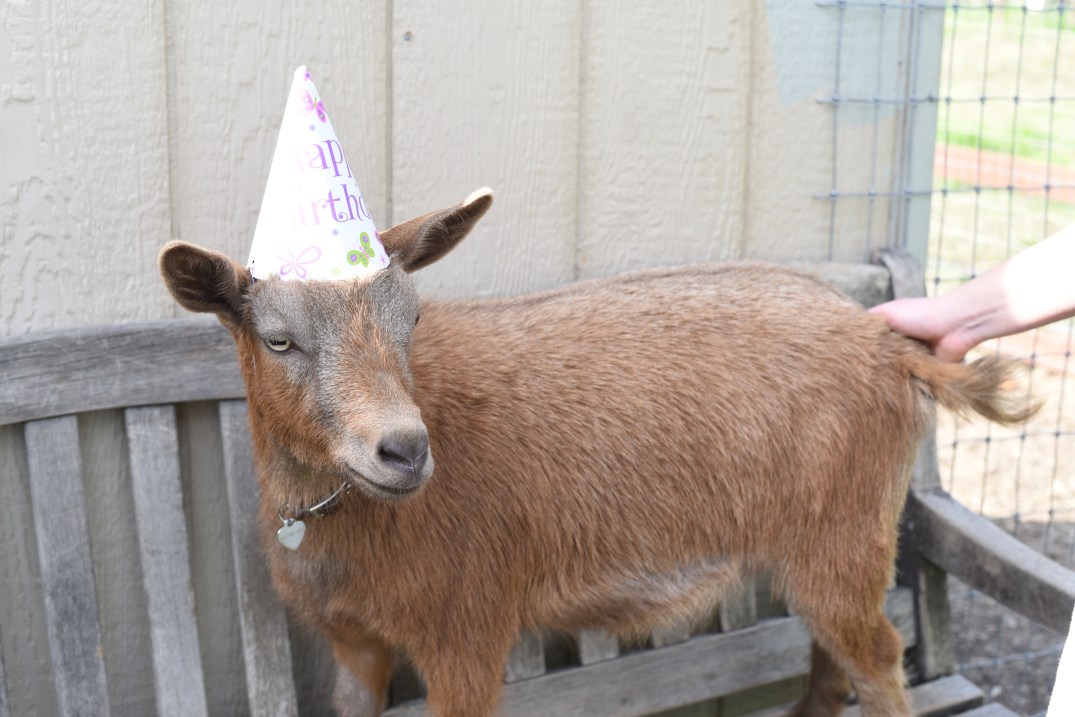
To celebrate Acorn’s 4th Birthday, she got a bouquet of organic roses from our front yard. She loves the flowers and doesn’t seem to have a preference for color or scent. After she eats the petals, she munches the leaves and then even the finer stems- thorns and all. Roses are healthy for goats, providing lots of good vitamin C. Although goats make their own vitamin C, according to Natural Goat Care, more is always better!

Acorn and Maple share a birthday. They were born the same day at the same farm, to mothers who were actually both Inspirations Chocolatte daughters. They’re technically cousins, but since they were both in the same pen at Nancy’s and we brought them home together at 8 weeks, they were raised as sisters. Maple had kidding complications and is now retired as a therapy goat at a Middle School, but we miss her, and are thinking about her today. And hoping she’s being treated to roses too.

Goat Herd Hierarchy

Spotting a little extra room on the chaise, Aspen jumped up and claimed it. Acorn nudged her but then stood as close to me as possible and chewed her cud, content with that position. Interestingly, Acorn is our Herd Queen. She could have made Aspen move, and if it had been Cedar or Summer, she would have. But Acorn adopted Aspen when I brought her home as a one week old bottle baby. Aspen cried out, missing her mama, and Acorn who was pregnant at the time, answered back. From then on Acorn defended Aspen, let her eat from under her, and never pushed her. So as the Herd Queen’s daughter, Aspen enjoys many privileges, including choice seating.

Nigerian Dwarf Goat Publicity

We took Pinecone for a Sunday walk in the park. She tasted the weeds, climbed a big rock, and met several small dogs. She watched some ducks in the pond, trying to figure out what they were, but wasn’t interested in crossing the small bridge across the creek. As usual, we didn’t get more than a few yards before we were stopped to answer questions about our little goatie and pose for pictures. We like to promote the breed whenever possible and love to talk goats!

Backyard Goats

IMG_2761

The girls stand by the gate to ask to come out to explore the backyard. They love the olive trees and beg for fresh leaves. Oak, redwood, photinia, roses, and orange leaves are also favorites. Usually they are so spoiled with their orchard grass and organic alfalfa that they have little interest in weeds, but today they tried mallow, filigree, dandelion, and several different grasses.

IMG_2771

Acorn found old ashes left from the burn pile and thought it would be a fun place to play.